

See It in Action
Explaining this blog using our AI video generation application, showcasing what our platform can produce.
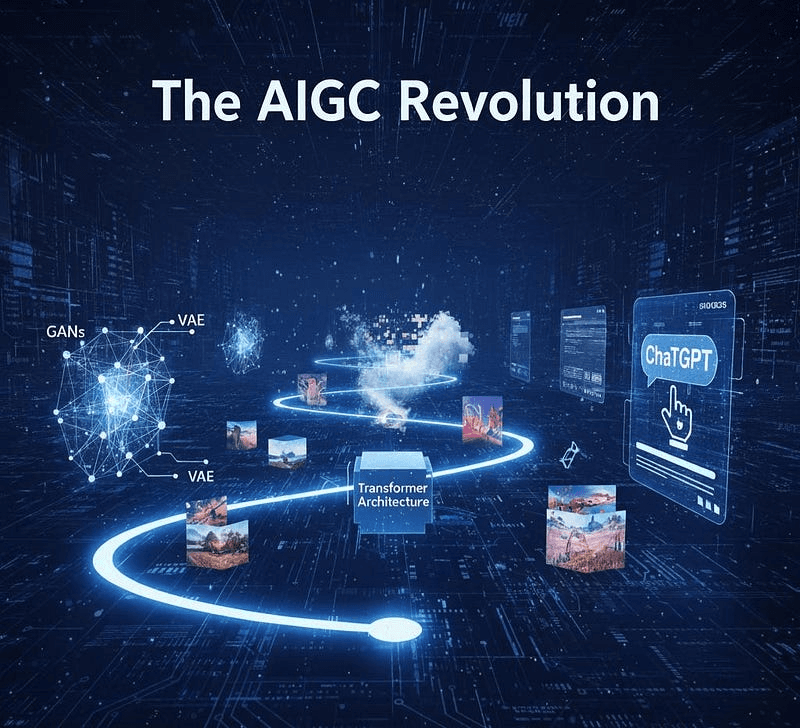
Let's talk about something that's quietly reshaping the world . If you've asked ChatGPT a question, been stunned by an image from DALL-E, or watched an AI-generated video, you've witnessed a kind of magic. But this magic isn't an overnight trick. It's the result of a decades-long technological revolution that is fundamentally changing how we create, communicate, and even think.
This is the AIGC - Artificial Intelligence Generated Content - Revolution.
From the early statistical models of the 1950s to the mind-bending power of today's large language models, the journey has been one of exponential growth. But how did we get here? What are the key breakthroughs, the "aha!" moments, that brought us from simple text generators to AI that can write code, compose music, and design art?
In this comprehensive post, we'll trace that exact history. We'll start with the simple definitions for beginners, journey through the "deep learning" breakthroughs for intermediate readers, and finally, dive into the advanced architectures that power the revolution today.
What is AIGC?
AIGC, or Artificial Intelligence Generated Content, simply refers to digital content - like images, music, articles, and code - that is created by an AI model rather than by a human.
Think of it as an incredibly skilled apprentice. You provide an instruction (a "prompt"), and the AI uses its vast training to generate something new. The core mission of AIGC is to make content creation faster, more accessible, and more efficient.
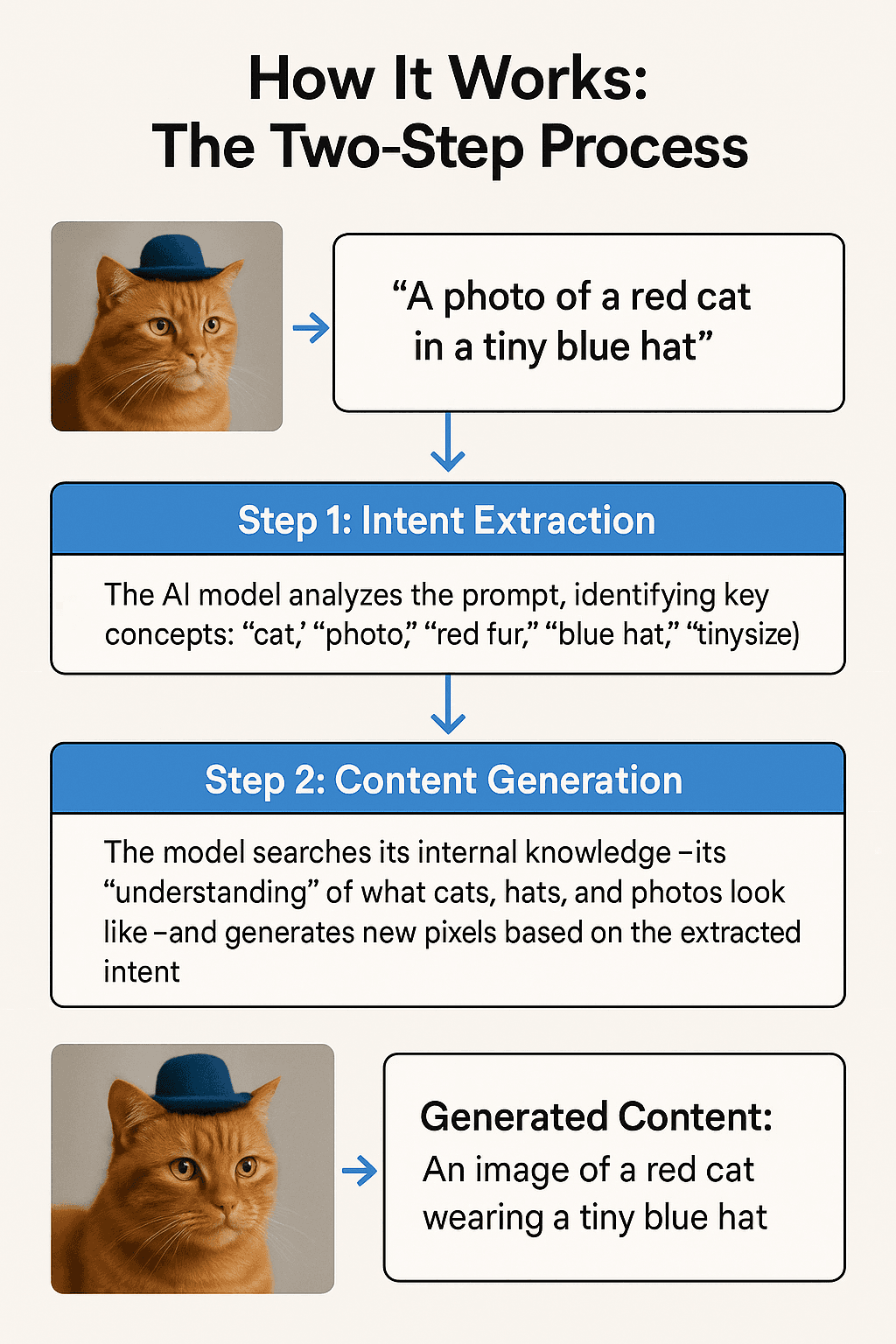
The Drivers of Modern AIGC
This two-step idea isn't new. So, why the sudden explosion? The difference between today's AIGC and older models lies in three key drivers:
- Massive Datasets: GPT-3 was trained on 570GB of text data, a colossal leap from GPT-2's 38GB. More data means the AI learns a more comprehensive and realistic "map" of the world.
- Bigger, Better Models: We are building more sophisticated "foundation models" (the "brains" of the operation).
- Immense Compute: We now have the specialized hardware (like GPUs and TPUs) needed to actually train these massive models.
The current flagships of this new era are models like ChatGPT (specialized in conversation),
DALL-E 2 (a master artist for text-to-image), and Codex (a programmer that speaks human language).
A Comprehensive History of Generative AI
To understand today's revolution, we have to look back. The history of generative models can be split into two major eras.
1. Early Foundations (Pre-Deep Learning Era)
Before the 2010s, models focused on generating sequential data, like text or speech. They were clever, but limited.
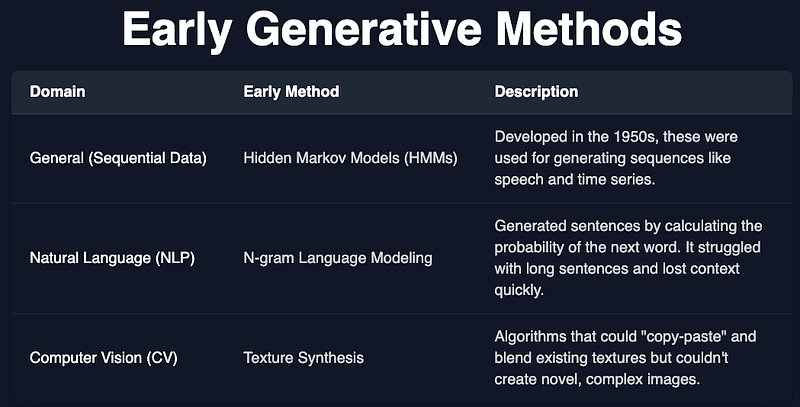
2. The Deep Learning Breakthroughs
This is when things got exciting. With the advent of deep learning, models gained the ability to learn complex patterns on their own.
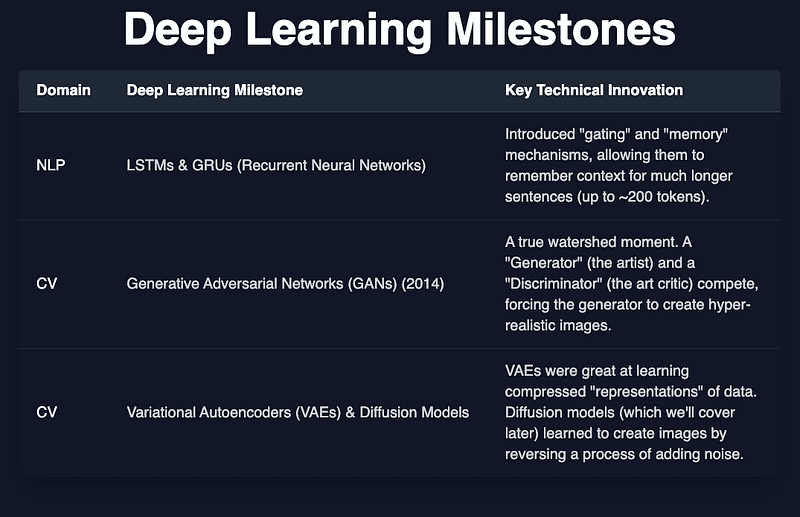
The Architectural Nexus: The Transformer (2017)
For years, NLP and CV models evolved on separate paths. Then, in 2017, a paper from Google titled "Attention Is All You Need " introduced the Transformer.
This was the missing piece :-
- Key Mechanism: The Transformer uses a "self-attention" mechanism. In simple terms, it can look at an entire sentence at once and decide which other words are most important for understanding any single word.
- The Impact: This was revolutionary. It was far better at handling long-term dependencies than LSTMs.
- The "Scaling" Enabler: Most importantly, the Transformer architecture was highly parallelizable. This means we could use massive GPU clusters to train enormous models - something that was painfully slow with older architectures.
The Transformer quickly became the dominant backbone for everything: BERT, the GPT series, and even models for computer vision and multimodal tasks.
Advanced Architectures and Modalities
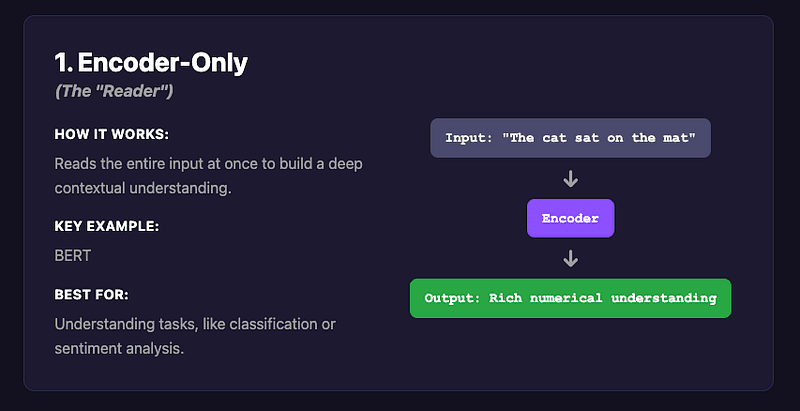
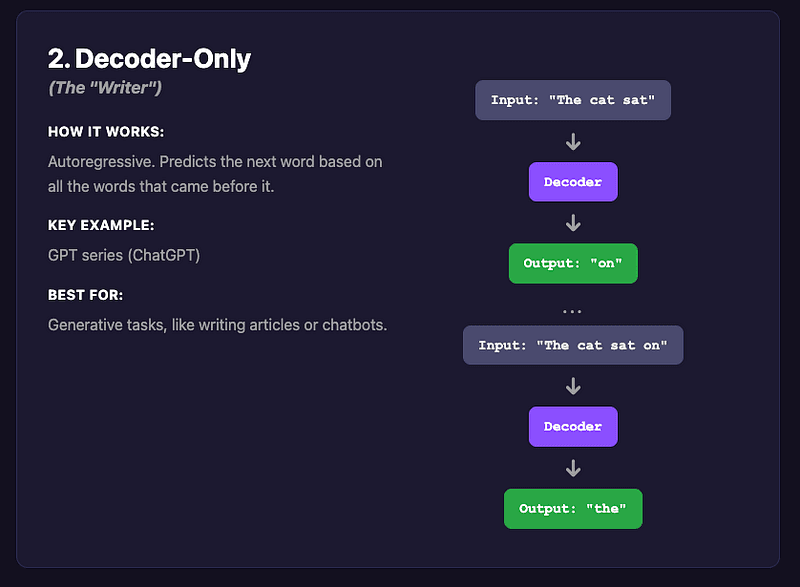
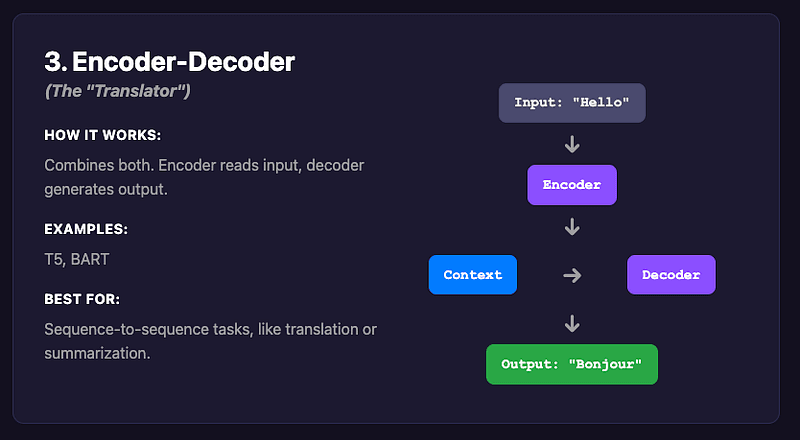
This brings us to the modern era. Today's AIGC models are all built on the Transformer, but they use it in three different ways.
Key Technical Innovations
Two other major innovations are crucial to today's AIGC :-
1. Reinforcement Learning from Human Feedback (RLHF)
- The Problem: An AI trained on the whole internet might be smart, but it can also be unhelpful, untruthful, or toxic.
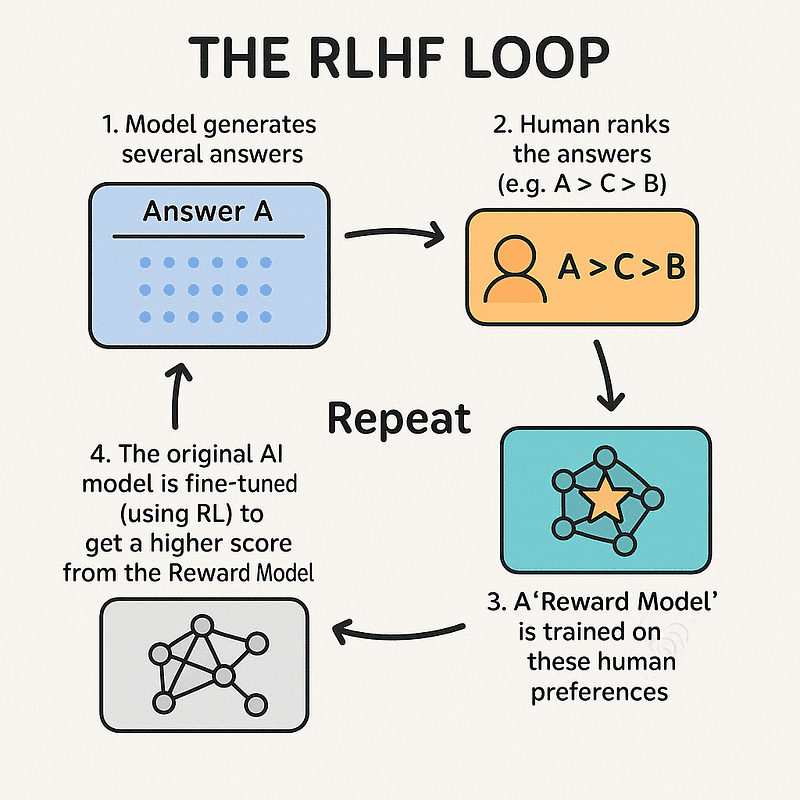
- The Solution (RLHF): This is the "secret sauce" of ChatGPT. It's a fine-tuning process where human feedback is used to "align" the model with human intent.
- How it Works: In simple terms, model outputs are ranked by human labelers. A separate "Reward Model" is trained to predict which outputs a human would prefer. Finally, the main AI model is fine-tuned to maximize the score from this Reward Model.
2. Diffusion Models This is the cutting-edge technique behind image generators like Stable Diffusion and DALL-E 2.
The model is trained in two steps:
- Forward Process (Corrupt): It learns by taking a clear image and progressively adding "noise" until it's just static.
- Reverse Process (Generate): It then learns how to reverse that process - starting from pure noise, it progressively removes the noise step-by-step until a clear image emerges.
- By guiding this "denoising" process with a text prompt (e.g., "a cat"), it can create stunningly detailed and novel images from scratch.
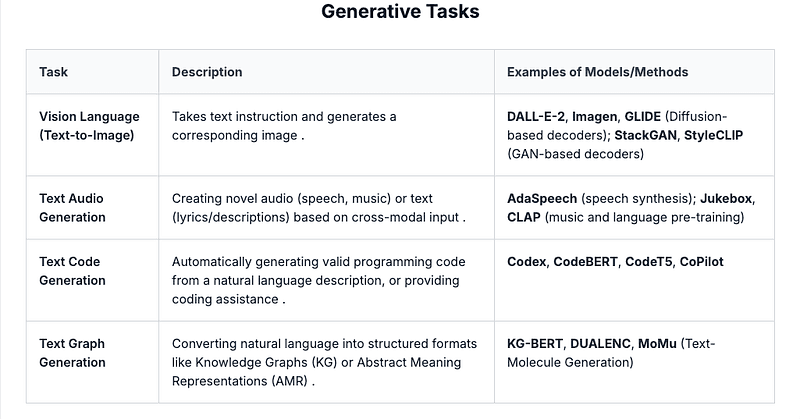
Multimodal Generation: Bridging Data Types
Multimodal AIGC models generate raw modalities by learning complex connections and interactions between different data types
Challenges and the Path to Responsible AI
As AIGC becomes ubiquitous, we face critical challenges. This power comes with immense responsibility.
Factuality & Misinformation
- The Risk: Models can "hallucinate" - generating confident-sounding but completely false or absurd answers.
- The Solution: Using RLHF to optimize for truthfulness (like WebGPT) and building in "fact-checking" steps.
Toxicity and Bias
- The Risk: Models trained on the internet learn the internet's biases, leading to stereotypical or toxic outputs.
- The Solution: Heavy fine-tuning (like with InstructGPT) and developing metrics to quantify safety based on human values.
Privacy Vulnerabilities
- The Risk: Large models can memorize and "leak" private data (like names or phone numbers) from their training sets.
- The Solution: Developing new privacy-preserving training techniques and data anonymization.
Reasoning and Reliability
- The Risk: Models can fail at basic common-sense reasoning.
- The Solution: New prompting techniques like "Chain-of-Thought" (CoT), which forces the model to "show its work" and explain its reasoning step-by-step.
Conclusion
The AIGC revolution is more than just a new set of tools. It's the emergence of a new creative collaborator.
We are moving from an era of information retrieval (like Google) to an era of information synthesis. The challenge ahead is not just to build bigger models, but to build wiser ones. The AIGC revolution has given us a powerful new partner, and our next great task is to learn how to work with it responsibly, ethically, and creatively.
This history is still being written, and the future is far from certain. That leaves us all with critical questions to consider.
We'd love to hear your thoughts in the comments:
-
As AI becomes a standard tool for art, music, and writing, what do you think it will mean to be a "creative" person in the next decade? Will the most valuable skill shift from the craft of creation to the vision of direction and curation?
-
When AIGC can generate realistic text, images, and video that are indistinguishable from human-made content, what happens to our concept of "truth" or "authenticity" online? What new systems might we need to verify what is real?